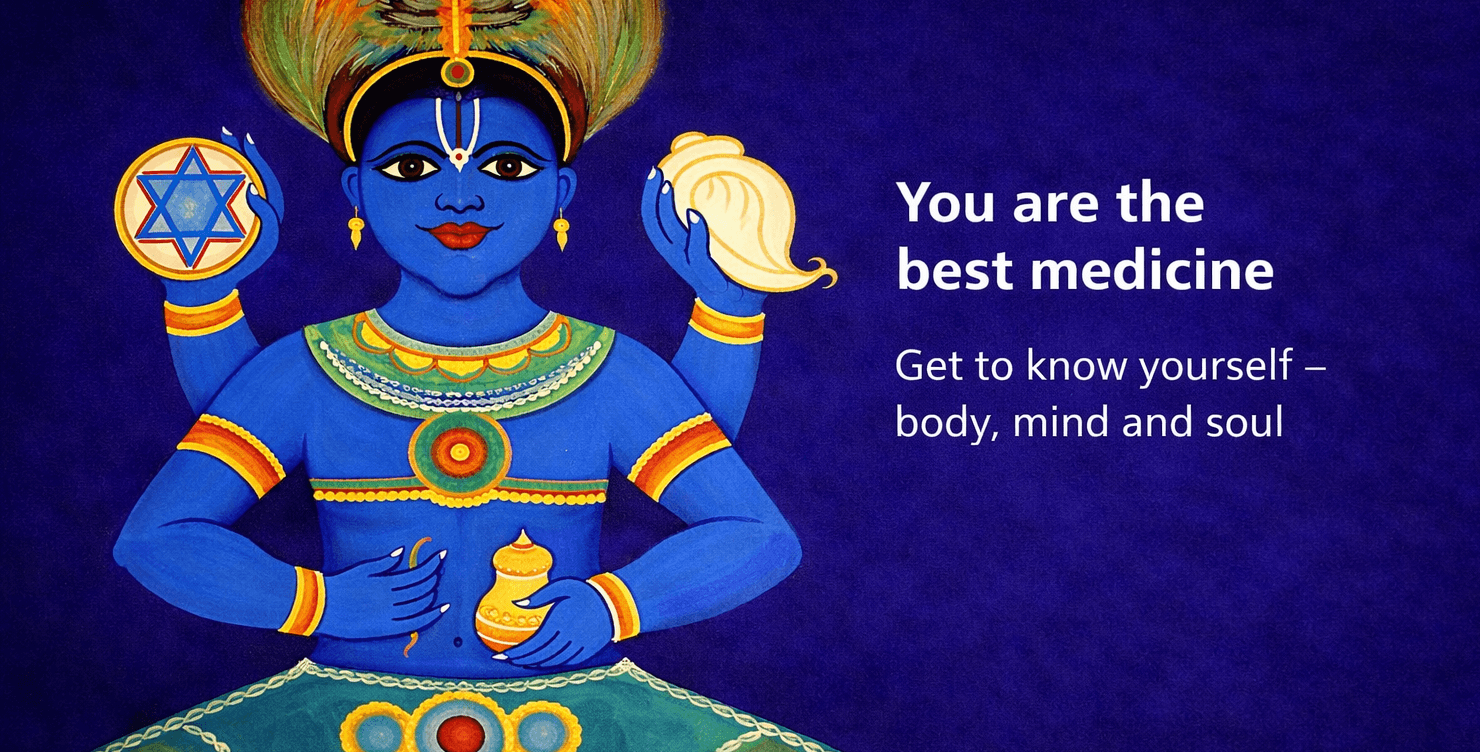

Ayurveda is a holistic science of life (Ayu = life, Veda = science) which has been passed on for thousands of years to promote longevity and prevent disease.
It considers and treats the individual as a whole - body, mind and spirit - through diet, lifestyle, plant-based medicine and manual treatments.
It invites us to consider whether our life is happy, beneficial and useful to ourselves and to society at large. And it poses the larger question as to whether our daily actions and thoughts are prolonging or shortening our life.
Prana is the Sanskrit word for breath. It is the life-giving force which permeates reality on all levels.
Doshas - the functional life energies
Doshas are the functional life energies based on nature's elements that govern physical, physiological, mental, and emotional health.
The doshas of the body are: Kapha (earth and water elements), Pitta (fire element) and Vata (wind and ether elements).
The doshas of the mind are: Tamas (inertia, darkness, ignorance) and Rajas (activity, desire, restlessness).
Sattva (purity, clarity, balance) is the desired state.
Each individual has a unique combination of these functional energies, which in Sanskrit is called Prakriti. Maintaining this individual balance is the key to health and longevity.
When this individual balance is getting disturbed by the aggravation of one or several doshas (Vikriti in Sanskrit), physical and mental illnesses arise.

Agni - the importance of digestion
In Ayurveda, digestion is considered the cornerstone of health and the main root cause of illness.
We often hear that we are what we eat. But actually, we are what we digest.
When the digestive fire (Agni in Sanskrit) is stable, it does not only extract the nutrients from the food we eat, it also properly digests our experiences, thoughts and emotions.
When it is disturbed, it leaves some food undigested, creating toxins (Ama in Sanskrit) which obstruct the body and the mind.
The key to keeping the digestion strong is to eat only when feeling hungry and to stop as soon as feeling full.
Pretty simple, yet so powerful, and not always embraced in today’s way of living…

The heart - mind - digestion connection
Ayurveda already uncovered the intrinsic connection between heart, mind and digestion over 5000 years ago.
It explains that a calm heart is the key to a stable mind which in turn is the foundation for a good digestion. The reverse holds true as well - a chronically unstable digestion ends up having a destabilizing effect on the mind and the resulting mental agitation is “drying up” the heart.
This is why it is so important to consider the individual as a whole, and to address the systemic causes of emotional, mental and digestive instabilities.
If you are struggling with your digestion or suffering from other physiological symptoms (such as chronic fatigue, shortness of breath, lack of drive, hyper-sensitivity), it is likely not only due to what you are eating. When you are eating it (aligned with your digestive fire) and how (in a state of emotional security and mental calm) is equally important, if not more.

The balance of the opposites
Ayurveda treats by the opposites (Vishesha cikitsa in Sanskrit). To reduce heat we apply cold, to reduce dryness we apply unctuousness, to reduce instability we introduce regularity…
It is a medicine based on qualities (Gunas in Sanskrit) rather than on quantities, such as calories. When we start seeing the world through the lens of “gunas”, we learn to recognize what is beneficial for us at a given time, based on the current state of our body and mind.
This being said, the first line of treatment in Ayurveda is to remove the cause of the imbalance (Nidana Parivarjana in Sanskrit). So, before (or in addition to) introducing the opposite qualities, we try to alleviate the causes which led to the aggravation.
That too is something we can learn to do for ourselves, as we are indeed our best medicine.

Are you ready to get to know yourself?